Menomonie industry and AI adoption research
Secure AI opportunities for Menomonie education, manufacturing, and regional agriculture
Menomonie’s public record connects geography, infrastructure, development history, and employment to higher education, manufacturing, and regional agriculture. For Menomonie, this report turns that evidence into bounded AI opportunities while treating security, privacy, safety, regulatory review, human authority, deployment, monitoring, maintenance, and controlled upgrades as core system requirements.
City context and industry evidence
Lumber created the industrial city and funded practical education12
Menomonie’s comprehensive plan traces the community from an eighteenth-century trading post to a major western Wisconsin lumber center. Knapp, Stout & Company employed thousands at its height and operated mills, shops, warehouses, and related infrastructure. James Huff Stout then founded a manual training school that became the University of Wisconsin–Stout. The important connection is documented institutional history: production skill, applied learning, and local economic development evolved together. For Menomonie, this evidence should lead to a precise operating question rather than a generic AI promise. A useful design must preserve the distinctions created by UW–Stout, manufacturing and food production, regional agriculture, workforce learning, local business services, and city-county-university collaboration. For Menomonie operations, before a person relies on an answer, the interface should identify the governing record, its owner and effective period, any unresolved contradiction, and the person or process authorized to decide what happens next.
City context and industry evidence
A polytechnic university keeps applied learning close to production21
UW–Stout describes a continuing mission of practical, career-focused education and a history tied to manufacturing, design, technology, and economic development. The city plan identifies university-supported incubation for manufacturing and food technology. That makes Menomonie a strong setting for bounded AI pilots involving curriculum operations, labs, research records, prototypes, quality evidence, and workforce training—without implying that the university or a local company endorses IMS. For Menomonie, this evidence should lead to a precise operating question rather than a generic AI promise. A useful design must preserve the distinctions created by UW–Stout, manufacturing and food production, regional agriculture, workforce learning, local business services, and city-county-university collaboration. For Menomonie operations, before a person relies on an answer, the interface should identify the governing record, its owner and effective period, any unresolved contradiction, and the person or process authorized to decide what happens next.
City context and industry evidence
Modern manufacturing operates inside a regional farm and food economy13
The city describes a substantial industrial base and a transition area between growing urban counties and rural surroundings. Its plan connects manufacturing, food technology, business incubation, transport, and regional agriculture. The workflow consequence is traceability across different owners: research samples, farm or ingredient records, prototype revisions, supplier evidence, production lots, equipment state, and distribution events cannot be merged safely without explicit purpose and provenance. For Menomonie, this evidence should lead to a precise operating question rather than a generic AI promise. A useful design must preserve the distinctions created by UW–Stout, manufacturing and food production, regional agriculture, workforce learning, local business services, and city-county-university collaboration. For Menomonie operations, before a person relies on an answer, the interface should identify the governing record, its owner and effective period, any unresolved contradiction, and the person or process authorized to decide what happens next.
City context and industry evidence
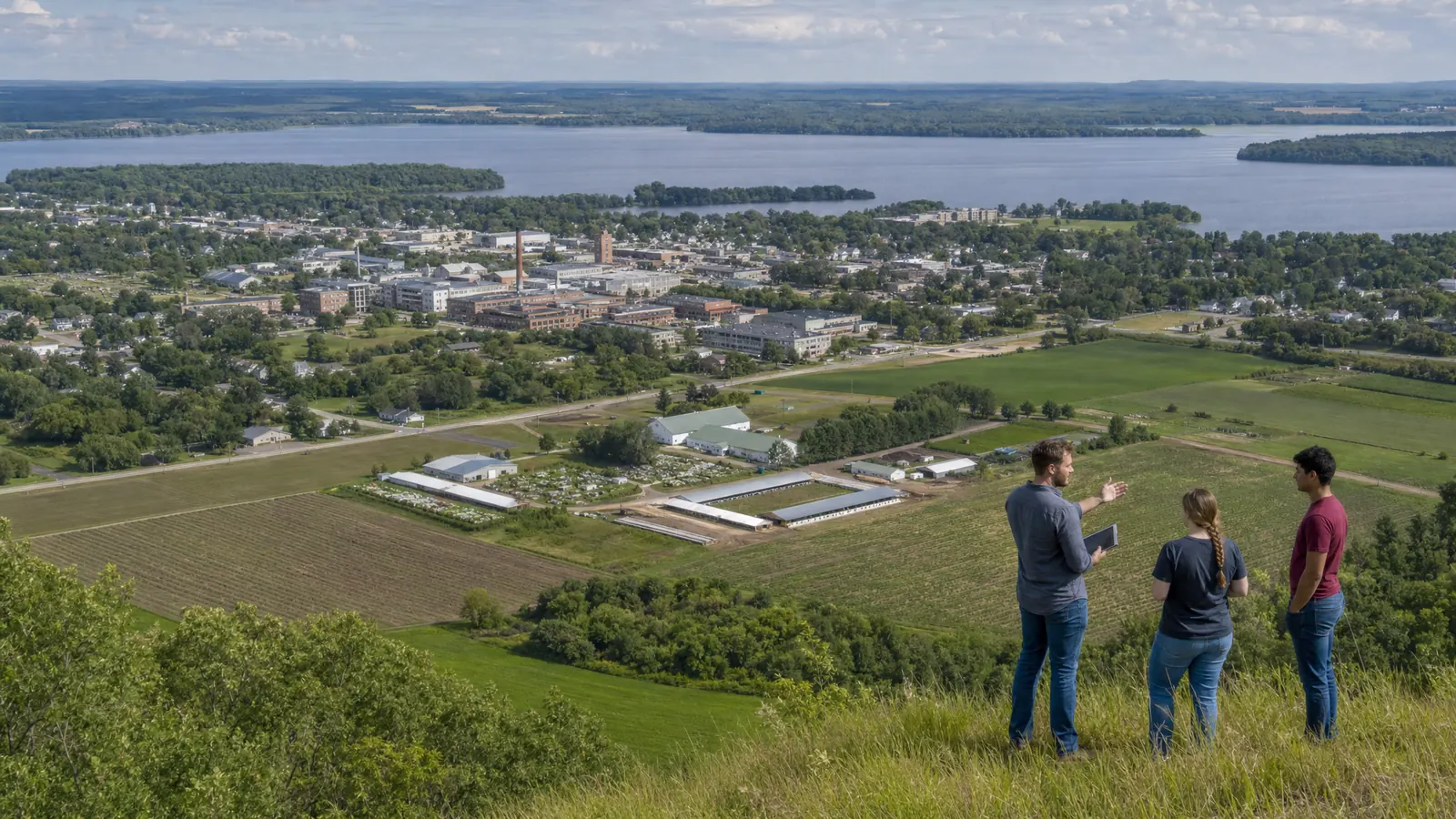
The Red Cedar and Lake Menomin make environmental context operational1
Menomonie is divided by the Red Cedar River and Lake Menomin, and Interstate 94 connects the city to Eau Claire and the St. Croix region. Water, land, transport, university, downtown, industry, and agriculture each affect development and operations. An AI system can help organize approved monitoring, planning, maintenance, or project records, but it should never infer environmental status from an image, replace scientific sampling, or claim causation beyond the source evidence. For Menomonie, this evidence should lead to a precise operating question rather than a generic AI promise. A useful design must preserve the distinctions created by UW–Stout, manufacturing and food production, regional agriculture, workforce learning, local business services, and city-county-university collaboration. For Menomonie operations, before a person relies on an answer, the interface should identify the governing record, its owner and effective period, any unresolved contradiction, and the person or process authorized to decide what happens next.
Current economic strengths
Industries shaping Menomonie, WI
Polytechnic higher education and applied research285
Applied education coordinates programs, labs, research, grants, prototypes, industry projects, facilities, student services, credentials, and workforce learning. AI can retrieve approved methods or assemble research lineage. It cannot decide grades, admission, aid, discipline, research ethics, intellectual-property rights, or accommodations, and it must preserve student, sponsor, researcher, and partner boundaries. For Polytechnic higher education and applied research in Menomonie, discovery should follow an actual case from intake through its final handoff and document where UW–Stout, manufacturing and food production, regional agriculture, workforce learning, local business services, and city-county-university collaboration changes the evidence or authority required. For Menomonie operations, the pilot dataset should include ordinary work as well as incomplete records, competing priorities, unavailable integrations, access restrictions, and the costly exceptions experienced by that workflow. For Menomonie operations, acceptance should be based on the named outcome and failure cost for this sector, not a single average accuracy score. For Menomonie operations, release remains conditional on accountable review, monitored operation, a usable manual route, and regression testing after changes to sources, permissions, prompts, models, or integrations. For Menomonie operations, for each candidate, teams should specify source authority, decision owner, exception path, measurable baseline, downstream queue, and failure cost before evaluating whether automation improves the entire workflow rather than one screen.
Manufacturing, design, and technology development126
Manufacturing and prototype teams manage requirements, designs, bills of material, software, equipment, tests, inspections, deviations, maintenance, suppliers, and release. A grounded assistant can prepare a design-history or exception packet. It must not alter a released requirement, approve a design, clear a safety issue, release product, or confuse prototype evidence with production evidence. For Manufacturing, design, and technology development in Menomonie, discovery should follow an actual case from intake through its final handoff and document where UW–Stout, manufacturing and food production, regional agriculture, workforce learning, local business services, and city-county-university collaboration changes the evidence or authority required. For Menomonie operations, the pilot dataset should include ordinary work as well as incomplete records, competing priorities, unavailable integrations, access restrictions, and the costly exceptions experienced by that workflow. For Menomonie operations, acceptance should be based on the named outcome and failure cost for this sector, not a single average accuracy score. For Menomonie operations, release remains conditional on accountable review, monitored operation, a usable manual route, and regression testing after changes to sources, permissions, prompts, models, or integrations. For Menomonie operations, for each candidate, teams should specify source authority, decision owner, exception path, measurable baseline, downstream queue, and failure cost before evaluating whether automation improves the entire workflow rather than one screen.
Regional agriculture and food technology175
Agriculture and food-technology workflows connect research, growers, ingredients, suppliers, samples, formulas, allergens, sanitation, processing, quality, traceability, and distribution. AI can help preserve sample or lot lineage for qualified review. It cannot infer a safe substitution, fabricate field conditions, release food, or apply one organization’s authority to another. For Regional agriculture and food technology in Menomonie, discovery should follow an actual case from intake through its final handoff and document where UW–Stout, manufacturing and food production, regional agriculture, workforce learning, local business services, and city-county-university collaboration changes the evidence or authority required. For Menomonie operations, the pilot dataset should include ordinary work as well as incomplete records, competing priorities, unavailable integrations, access restrictions, and the costly exceptions experienced by that workflow. For Menomonie operations, acceptance should be based on the named outcome and failure cost for this sector, not a single average accuracy score. For Menomonie operations, release remains conditional on accountable review, monitored operation, a usable manual route, and regression testing after changes to sources, permissions, prompts, models, or integrations. For Menomonie operations, for each candidate, teams should specify source authority, decision owner, exception path, measurable baseline, downstream queue, and failure cost before evaluating whether automation improves the entire workflow rather than one screen.
Practical opportunities
AI applications for local industry workflows
Applied research and prototype lineage25
Workflow: Connect approved protocol, requirement, design, sample, software, test, review, and retention records while separating projects and sponsors. Test cases should reproduce the delayed, partial, inaccessible, and contradictory evidence that staff encounter across UW–Stout, manufacturing and food production, regional agriculture, workforce learning, local business services, and city-county-university collaboration, with a named fallback whenever the connected data cannot support action.
Potential value: Test missing approvals, wrong-version rejection, cross-project isolation, reproducibility, and reviewer disagreement. For Menomonie operations, that evidence makes it possible to distinguish a retrieval defect from a stale source, access problem, integration failure, or human override and to determine whether a later update changed performance. For Menomonie operations, pilot review should compare performance across roles, shifts, languages, accessibility needs, and disruption conditions rather than average performance only.
Required controls
- Approved sources and purpose
- Least-privilege role access
- Evidence-linked human review
- Monitored fallback and controlled change
Role-specific lab and shop procedure guide26
Workflow: Retrieve the current approved method, hazard, equipment, training, supervisor, and emergency path for a defined task. Test cases should reproduce the delayed, partial, inaccessible, and contradictory evidence that staff encounter across UW–Stout, manufacturing and food production, regional agriculture, workforce learning, local business services, and city-county-university collaboration, with a named fallback whenever the connected data cannot support action.
Potential value: Measure obsolete-procedure rejection, wrong-equipment identity, expired training, accessibility, and safe escalation. For Menomonie operations, that evidence makes it possible to distinguish a retrieval defect from a stale source, access problem, integration failure, or human override and to determine whether a later update changed performance. For Menomonie operations, pilot review should compare performance across roles, shifts, languages, accessibility needs, and disruption conditions rather than average performance only.
Required controls
- Approved sources and purpose
- Least-privilege role access
- Evidence-linked human review
- Monitored fallback and controlled change
Manufacturing design-history evidence packet15
Workflow: Assemble authorized requirement, drawing, software, material, risk, test, deviation, approval, and release evidence by product stage. Test cases should reproduce the delayed, partial, inaccessible, and contradictory evidence that staff encounter across UW–Stout, manufacturing and food production, regional agriculture, workforce learning, local business services, and city-county-university collaboration, with a named fallback whenever the connected data cannot support action.
Potential value: Track missing-record recall, prototype-production separation, false conclusions, corrections, and review time. For Menomonie operations, that evidence makes it possible to distinguish a retrieval defect from a stale source, access problem, integration failure, or human override and to determine whether a later update changed performance. For Menomonie operations, pilot review should compare performance across roles, shifts, languages, accessibility needs, and disruption conditions rather than average performance only.
Required controls
- Approved sources and purpose
- Least-privilege role access
- Evidence-linked human review
- Monitored fallback and controlled change
Agricultural and food research sample lineage17
Workflow: Link authorized source, location, time, condition, transformation, test, analyst, and disposition records for a sample or lot. Test cases should reproduce the delayed, partial, inaccessible, and contradictory evidence that staff encounter across UW–Stout, manufacturing and food production, regional agriculture, workforce learning, local business services, and city-county-university collaboration, with a named fallback whenever the connected data cannot support action.
Potential value: Test broken chains, duplicate identity, wrong geography, unavailable measurements, and reproducibility. For Menomonie operations, that evidence makes it possible to distinguish a retrieval defect from a stale source, access problem, integration failure, or human override and to determine whether a later update changed performance. For Menomonie operations, pilot review should compare performance across roles, shifts, languages, accessibility needs, and disruption conditions rather than average performance only.
Required controls
- Approved sources and purpose
- Least-privilege role access
- Evidence-linked human review
- Monitored fallback and controlled change
Supplier and material exception brief16
Workflow: Combine approved order, supplier, specification, lot, inspection, inventory, carrier, and delivery events in a cited chronology. Test cases should reproduce the delayed, partial, inaccessible, and contradictory evidence that staff encounter across UW–Stout, manufacturing and food production, regional agriculture, workforce learning, local business services, and city-county-university collaboration, with a named fallback whenever the connected data cannot support action.
Potential value: Monitor missed exceptions, stale status, false alerts, queue age, and manual corrections. For Menomonie operations, that evidence makes it possible to distinguish a retrieval defect from a stale source, access problem, integration failure, or human override and to determine whether a later update changed performance. For Menomonie operations, pilot review should compare performance across roles, shifts, languages, accessibility needs, and disruption conditions rather than average performance only.
Required controls
- Approved sources and purpose
- Least-privilege role access
- Evidence-linked human review
- Monitored fallback and controlled change
Business and innovation resource guide34
Workflow: Route an organization to approved city, university, county, or development resources with eligibility, owner, date, and next step. Test cases should reproduce the delayed, partial, inaccessible, and contradictory evidence that staff encounter across UW–Stout, manufacturing and food production, regional agriculture, workforce learning, local business services, and city-county-university collaboration, with a named fallback whenever the connected data cannot support action.
Potential value: Test outdated programs, wrong jurisdiction, inaccessible content, invented eligibility, and successful human handoff. For Menomonie operations, that evidence makes it possible to distinguish a retrieval defect from a stale source, access problem, integration failure, or human override and to determine whether a later update changed performance. For Menomonie operations, pilot review should compare performance across roles, shifts, languages, accessibility needs, and disruption conditions rather than average performance only.
Required controls
- Approved sources and purpose
- Least-privilege role access
- Evidence-linked human review
- Monitored fallback and controlled change
Risk and accountability
Security, privacy, safety, and compliance
Intended use, evidence, and accountable authority5
In Menomonie, intended-use review must name the exact workflow, affected people, approved records, allowed outputs, prohibited actions, failure consequences, and accountable owner. The review should explicitly consider UW–Stout, manufacturing and food production, regional agriculture, workforce learning, local business services, and city-county-university collaboration. For Menomonie operations, material output must expose its source, version, scope, freshness, and uncertainty. For Menomonie operations, validation records representative and adverse cases, measurable thresholds, exceptions, approvals, unresolved limitations, and rollback criteria. For Menomonie operations, changes to connected sources, permissions, prompts, models, interfaces, or integrations receive a documented impact review and proportionate regression testing before release.
Privacy, security, and separation of records658
Data architecture for Menomonie should separate the organizations, sites, customers, employees, students, patients, visitors, parcels, or regulated records implicated by UW–Stout, manufacturing and food production, regional agriculture, workforce learning, local business services, and city-county-university collaboration. For Menomonie operations, apply purpose limitation, minimum access, environment separation, protected secrets, secure transfer and storage, audit logging, upload screening, permission inheritance, retention rules, and access recertification. For Menomonie operations, generated summaries, embeddings, caches, prompts, traces, and support logs can reproduce protected information and therefore require the same inventory and disposal discipline. For Menomonie operations, security tests should cover revoked identities, cross-boundary retrieval, malicious documents, indirect disclosure, bulk export, and unavailable identity services.
Safe failure, monitoring, maintenance, and recovery56
Operational monitoring in Menomonie must follow the real consequences of UW–Stout, manufacturing and food production, regional agriculture, workforce learning, local business services, and city-county-university collaboration, not just server uptime. For Menomonie operations, track citation failures, missed exceptions, false alerts, reviewer disagreement, access violations, queue age, drift, latency, corrections, and manual-route use separately. For Menomonie operations, an attractive interface does not establish that the complete decision remains safe. For Menomonie operations, when evidence conflicts, an integration fails, identity cannot be verified, or authority is absent, preserve the work, block the prohibited action, and route the case to a named person through a tested procedure. For Menomonie operations, maintain inventories, controlled releases, rollback, incident response, backup and recovery, reassigned escalations, and planned retirement for models, prompts, source indexes, permissions, and dependencies.
Formal software lifecycle
From scoped opportunity to maintained system
- 01
Choose one bounded workflow
Document users, systems, records, decisions, exceptions, baseline performance, failure consequences, governing requirements, accountable owners, and the manual fallback before model selection.
- 02
Design the evidence and authority boundary
Specify approved sources, roles, citations, prohibited actions, escalation, retention, accessibility, security, logging, correction, and acceptance thresholds in a reviewable design.
- 03
Build a contained read-only pilot
Use minimized representative data, separate environments, protected configuration, read-only connections where practical, visible source state, explicit uncertainty, and complete test instrumentation.
- 04
Challenge routine and adverse cases
Test common, rare, stale, conflicting, inaccessible, malicious, and unavailable-data cases plus privacy, security, accessibility, recovery, escalation, and human-review performance.
- 05
Deploy and maintain the whole workflow
Release in stages, sample outcomes, review corrections and incidents, recertify access, test recovery, monitor drift, and require impact analysis and regression evidence for material upgrades.
How this report was prepared
Methodology and evidence limits
IMS reviewed official Menomonie history, adopted planning, economic-development and infrastructure material, plus applicable federal AI, cybersecurity, health, education, food, or quality guidance, accessed August 27, 2026. Employer names and civic promotion were not used as proof of demand or adoption. Proposed applications are testable opportunities, not claims that local organizations use them or that benefits are guaranteed. Each organization must complete its own discovery, legal and regulatory analysis, data approval, validation, security review, human-oversight design, deployment controls, monitoring, maintenance, and change management.
Evidence
Sources
- City of Menomonie 2016–2036 Comprehensive PlanCity of Menomonie, 2024-01-01
- UW–Stout HistoryUniversity of Wisconsin–Stout, 2026-08-27
- BusinessCity of Menomonie, 2026-08-27
- Menomonie, Dunn County, UW–Stout collaborating on economic developmentUniversity of Wisconsin–Stout, 2024-02-29
- Artificial Intelligence Risk Management Framework (AI RMF 1.0)National Institute of Standards and Technology, 2023-01-26
- Secure by DesignCybersecurity and Infrastructure Security Agency, 2023-04-13
- Current Good Manufacturing Practices for FoodU.S. Food and Drug Administration, 2024-02-22
- Family Educational Rights and Privacy ActU.S. Department of Education, 2026-08-27
FAQ
Questions about AI and Menomonie, WI
Does IMS claim a Menomonie office or clients?
No. This report analyzes public information and proposes workflow opportunities. It does not claim a Menomonie office, client relationship, endorsement, or completed project.
What is a reasonable first Menomonie AI pilot?
A narrow, read-only workflow such as an applied-research lineage tool or manufacturing design-history packet is easier to govern than autonomous decisions or transactions.
Can an AI assistant combine all available business records?
Not safely by default. Every source needs a permitted purpose, owner, access rule, retention policy, security boundary, quality standard, and tested use. Technical access does not establish authority.
What should happen after an AI pilot works?
Validate the end-to-end workflow, deploy in stages, monitor real corrections and failure modes, maintain a human fallback, recertify access, test recovery, and control every material source, model, prompt, permission, and integration update.