Burnsville industry and AI adoption research
Secure AI opportunities for Burnsville healthcare, manufacturing, and regional services
Burnsville’s public record connects its geography, infrastructure, development history, and mature employment centers to healthcare, manufacturing, and regional services. For Burnsville, this report turns that evidence into bounded AI opportunities for real workflows while treating security, privacy, safety, regulatory review, human authority, deployment, monitoring, maintenance, and controlled upgrades as core system requirements.
City context and industry evidence
River, bluff, and Dakota history precede the modern city1
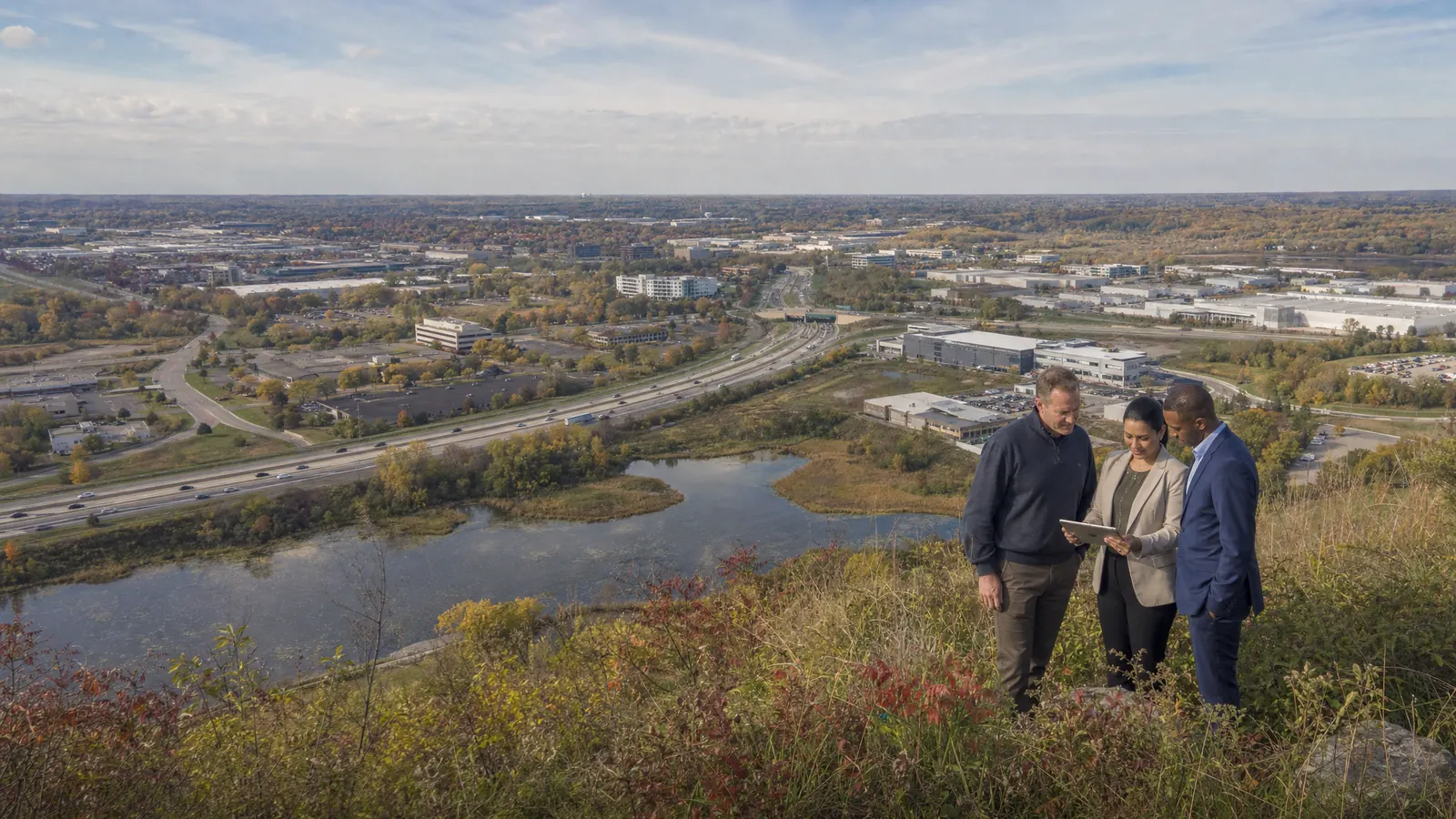
Burnsville occupies the south bluff of the Minnesota River near its meeting with the Mississippi system. The adopted comprehensive plan records long Dakota presence in the valley and Black Dog village near the river. Later settlement produced a rural farming community before rapid suburban development and incorporation in 1964. The valley, bluff, wetlands, lakes, and preserved land continue to define the city’s northern edge. This report uses that history carefully: it explains geography and successive land uses without treating cultural history as a marketing device or claiming a simple causal line to present employers. For Burnsville, this evidence should lead to a precise operating question rather than a generic AI promise. A useful design must preserve the distinctions created by the river-bluff setting, the I-35 junction, distinct employment centers, and the different evidence needs of healthcare, production, retail, and redevelopment. For Burnsville operations, before a person relies on an answer, the interface should identify the governing record, its owner and effective period, any unresolved contradiction, and the person or process authorized to decide what happens next.
City context and industry evidence
The I-35 split organized regional access and employment centers13
Interstates 35W and 35E, Highway 13, County Road 42, nearby airport access, and transit connections place Burnsville at a regional junction. The city’s plan identifies several distinct employment centers rather than one downtown-only economy: business parks, a healthcare campus, the regional commercial district, and Heart of the City. Each center has different records, risks, users, and service patterns. An AI system serving one cannot assume it has authority or complete information in another. For Burnsville, this evidence should lead to a precise operating question rather than a generic AI promise. A useful design must preserve the distinctions created by the river-bluff setting, the I-35 junction, distinct employment centers, and the different evidence needs of healthcare, production, retail, and redevelopment. For Burnsville operations, before a person relies on an answer, the interface should identify the governing record, its owner and effective period, any unresolved contradiction, and the person or process authorized to decide what happens next.
City context and industry evidence
Adopted planning evidence supports healthcare and manufacturing focus12
Burnsville’s 2040 plan ranked the city strongly in manufacturing, healthcare, and retail employment relative to its population rank at the time of the analysis. Current city economic-development material describes more than 200 healthcare-related businesses and a substantial manufacturing and information-technology presence. Those are city-reported indicators with dates and definitions, not guarantees about future growth. They justify detailed examination of quality, referral, maintenance, supplier, customer-service, and knowledge workflows while avoiding claims about individual companies. For Burnsville, this evidence should lead to a precise operating question rather than a generic AI promise. A useful design must preserve the distinctions created by the river-bluff setting, the I-35 junction, distinct employment centers, and the different evidence needs of healthcare, production, retail, and redevelopment. For Burnsville operations, before a person relies on an answer, the interface should identify the governing record, its owner and effective period, any unresolved contradiction, and the person or process authorized to decide what happens next.
City context and industry evidence
A mature suburb must maintain and adapt existing districts12
Burnsville’s business parks largely developed over several decades, while the regional retail area, Heart of the City, and aging industrial properties face continuing reinvestment and service needs. Redevelopment adds coordination among owners, tenants, contractors, agencies, utilities, customers, and residents. AI can make an approved record set easier to navigate or show unresolved obligations, but it should not collapse separate stakeholder positions into a fictional consensus. Source status, dates, ownership, and approval remain essential. For Burnsville, this evidence should lead to a precise operating question rather than a generic AI promise. A useful design must preserve the distinctions created by the river-bluff setting, the I-35 junction, distinct employment centers, and the different evidence needs of healthcare, production, retail, and redevelopment. For Burnsville operations, before a person relies on an answer, the interface should identify the governing record, its owner and effective period, any unresolved contradiction, and the person or process authorized to decide what happens next.
Current economic strengths
Industries shaping Burnsville, MN
Healthcare and medical services126
Burnsville’s healthcare campus and city-reported healthcare business base support administrative workflows around referrals, appointments, records, claims, staffing, facilities, and patient communication. The safest early applications organize evidence and incomplete handoffs rather than provide diagnosis, treatment, clinical triage, or coverage decisions. Protected information needs a permitted purpose, minimum-necessary access, secure exchange, audit, retention, incident response, and accountable review. Testing should include missing consent, mismatched identity, unusual formats, language and accessibility needs, urgent content, duplicate records, and system downtime so automation does not quietly delay care. For Healthcare and medical services in Burnsville, discovery should follow an actual case from intake through its final handoff and document where the river-bluff setting, the I-35 junction, distinct employment centers, and the different evidence needs of healthcare, production, retail, and redevelopment changes the evidence or authority required. For Burnsville operations, the pilot dataset should include ordinary work as well as incomplete records, competing priorities, unavailable integrations, access restrictions, and the costly exceptions experienced by that workflow. For Burnsville operations, acceptance should be based on the named outcome and failure cost for this sector, not a single average accuracy score. For Burnsville operations, release remains conditional on accountable review, monitored operation, a usable manual route, and regression testing after changes to sources, permissions, prompts, models, or integrations.
Manufacturing, aerospace supply, and technical production1275
Burnsville’s plan identifies established business parks and manufacturing employment. Production environments may coordinate specifications, work instructions, inspections, equipment, nonconformance, suppliers, training, maintenance, and shipping. AI can retrieve released evidence, compare versions, or assemble a review queue. It must not change a specification, approve a deviation, assign root cause, release product, bypass a lockout, or declare regulatory compliance. Covered medical-device work may also implicate FDA quality-system requirements. Each organization must define applicability and validate its own intended use with rare failure modes and representative records. For Manufacturing, aerospace supply, and technical production in Burnsville, discovery should follow an actual case from intake through its final handoff and document where the river-bluff setting, the I-35 junction, distinct employment centers, and the different evidence needs of healthcare, production, retail, and redevelopment changes the evidence or authority required. For Burnsville operations, the pilot dataset should include ordinary work as well as incomplete records, competing priorities, unavailable integrations, access restrictions, and the costly exceptions experienced by that workflow. For Burnsville operations, acceptance should be based on the named outcome and failure cost for this sector, not a single average accuracy score. For Burnsville operations, release remains conditional on accountable review, monitored operation, a usable manual route, and regression testing after changes to sources, permissions, prompts, models, or integrations.
Regional commerce, property, and professional services314
Burnsville Center, Heart of the City, business parks, transit, hospitality, and professional services generate recurring customer, tenant, vendor, inventory, reservation, maintenance, event, and facility coordination. AI can identify a conflict or retrieve an approved answer, but separate property owners, tenants, carriers, and service providers retain distinct systems and authority. Seasonal demand, redevelopment, vacancies, new tenants, weather, and events change normal patterns. Monitoring should cover missed exceptions, stale integrations, false urgency, accessibility, human override, and customer corrections rather than only transaction volume. For Regional commerce, property, and professional services in Burnsville, discovery should follow an actual case from intake through its final handoff and document where the river-bluff setting, the I-35 junction, distinct employment centers, and the different evidence needs of healthcare, production, retail, and redevelopment changes the evidence or authority required. For Burnsville operations, the pilot dataset should include ordinary work as well as incomplete records, competing priorities, unavailable integrations, access restrictions, and the costly exceptions experienced by that workflow. For Burnsville operations, acceptance should be based on the named outcome and failure cost for this sector, not a single average accuracy score. For Burnsville operations, release remains conditional on accountable review, monitored operation, a usable manual route, and regression testing after changes to sources, permissions, prompts, models, or integrations.
Practical opportunities
AI applications for local industry workflows
Referral and appointment readiness queue64
Workflow: Check authorized administrative packets for required documents, duplicates, conflicts, and missing consent. Prepare a review queue without interpreting symptoms, setting urgency, deciding coverage, or contacting patients automatically. Test cases should reproduce the delayed, partial, inaccessible, and contradictory evidence that staff encounter across the river-bluff setting, the I-35 junction, distinct employment centers, and the different evidence needs of healthcare, production, retail, and redevelopment, with a named fallback whenever the connected data cannot support action.
Potential value: Measure completeness precision, preventable delay, corrections, privacy events, queue age, and results across referral sources, languages, and formats. Preserve a clear manual route for uncertain identity or urgent content. For Burnsville operations, that evidence makes it possible to distinguish a retrieval defect from a stale source, access problem, integration failure, or human override and to determine whether a later update changed performance.
Required controls
- Approved sources and purpose
- Least-privilege role access
- Evidence-linked human review
- Monitored fallback and controlled change
Production quality chronology assistant74
Workflow: Link released procedures, inspections, deviations, supplier evidence, complaints, and training into a source-cited chronology for qualified review. Keep original records unchanged and visible. Test cases should reproduce the delayed, partial, inaccessible, and contradictory evidence that staff encounter across the river-bluff setting, the I-35 junction, distinct employment centers, and the different evidence needs of healthcare, production, retail, and redevelopment, with a named fallback whenever the connected data cannot support action.
Potential value: Test citation accuracy, missed records, false relationships, stale revision rejection, and reviewer changes. Prohibit automatic root cause, disposition, release, reportability, or approval. For Burnsville operations, that evidence makes it possible to distinguish a retrieval defect from a stale source, access problem, integration failure, or human override and to determine whether a later update changed performance.
Required controls
- Approved sources and purpose
- Least-privilege role access
- Evidence-linked human review
- Monitored fallback and controlled change
Equipment maintenance evidence organizer54
Workflow: Assemble authorized manuals, work orders, alarms, parts history, inspection requirements, and prior corrective work. Show conflicts and missing records to maintenance specialists. Test cases should reproduce the delayed, partial, inaccessible, and contradictory evidence that staff encounter across the river-bluff setting, the I-35 junction, distinct employment centers, and the different evidence needs of healthcare, production, retail, and redevelopment, with a named fallback whenever the connected data cannot support action.
Potential value: Compare time to diagnose the record set, unsupported suggestions, missed safety prerequisites, repeat failure, and downtime. The tool cannot authorize hazardous work or return equipment to service. For Burnsville operations, that evidence makes it possible to distinguish a retrieval defect from a stale source, access problem, integration failure, or human override and to determine whether a later update changed performance.
Required controls
- Approved sources and purpose
- Least-privilege role access
- Evidence-linked human review
- Monitored fallback and controlled change
Business-park tenant and facility handoff15
Workflow: Create a time-stamped brief from approved property, vendor, access, utility, and service records when an issue crosses tenant and facility boundaries. Identify each accountable owner. Test cases should reproduce the delayed, partial, inaccessible, and contradictory evidence that staff encounter across the river-bluff setting, the I-35 junction, distinct employment centers, and the different evidence needs of healthcare, production, retail, and redevelopment, with a named fallback whenever the connected data cannot support action.
Potential value: Measure transfer count, duplicate dispatch, stale status, false priority, and time to accepted ownership. Never merge private tenant records or promise work without authority. For Burnsville operations, that evidence makes it possible to distinguish a retrieval defect from a stale source, access problem, integration failure, or human override and to determine whether a later update changed performance.
Required controls
- Approved sources and purpose
- Least-privilege role access
- Evidence-linked human review
- Monitored fallback and controlled change
Regional customer-service exception queue34
Workflow: Surface approved exceptions across reservations, orders, inventory, delivery, events, and facilities. Explain the source and priority rule while leaving transactions read-only. Test cases should reproduce the delayed, partial, inaccessible, and contradictory evidence that staff encounter across the river-bluff setting, the I-35 junction, distinct employment centers, and the different evidence needs of healthcare, production, retail, and redevelopment, with a named fallback whenever the connected data cannot support action.
Potential value: Evaluate missed exceptions, alert fatigue, corrections, peak-period performance, and accessibility. Refunds, staffing, customer promises, and contract interpretations remain human actions. For Burnsville operations, that evidence makes it possible to distinguish a retrieval defect from a stale source, access problem, integration failure, or human override and to determine whether a later update changed performance.
Required controls
- Approved sources and purpose
- Least-privilege role access
- Evidence-linked human review
- Monitored fallback and controlled change
Controlled manufacturing and service learning guide75
Workflow: Present released role-specific safety, quality, privacy, equipment, and customer-service material with citations and supervised exercises. Retire explanations when governing content changes. Test cases should reproduce the delayed, partial, inaccessible, and contradictory evidence that staff encounter across the river-bluff setting, the I-35 junction, distinct employment centers, and the different evidence needs of healthcare, production, retail, and redevelopment, with a named fallback whenever the connected data cannot support action.
Potential value: Measure comprehension and observed proficiency across roles and shifts. Do not replace required qualification, hands-on demonstration, professional instruction, or supervisor accountability. For Burnsville operations, that evidence makes it possible to distinguish a retrieval defect from a stale source, access problem, integration failure, or human override and to determine whether a later update changed performance.
Required controls
- Approved sources and purpose
- Least-privilege role access
- Evidence-linked human review
- Monitored fallback and controlled change
Risk and accountability
Security, privacy, safety, and compliance
Intended use, evidence, and accountable authority4
In Burnsville, intended-use review must name the exact workflow, affected people, approved records, allowed outputs, prohibited actions, failure consequences, and accountable owner. The review should explicitly consider the river-bluff setting, the I-35 junction, distinct employment centers, and the different evidence needs of healthcare, production, retail, and redevelopment. For Burnsville operations, material output must expose its source, version, scope, freshness, and uncertainty. For Burnsville operations, validation records representative and adverse cases, measurable thresholds, exceptions, approvals, unresolved limitations, and rollback criteria. For Burnsville operations, changes to connected sources, permissions, prompts, models, interfaces, or integrations receive a documented impact review and proportionate regression testing before release.
Privacy, security, and separation of records546
Data architecture for Burnsville should separate the organizations, sites, customers, employees, students, patients, visitors, parcels, or regulated records implicated by the river-bluff setting, the I-35 junction, distinct employment centers, and the different evidence needs of healthcare, production, retail, and redevelopment. For Burnsville operations, apply purpose limitation, minimum access, environment separation, protected secrets, secure transfer and storage, audit logging, upload screening, permission inheritance, retention rules, and access recertification. For Burnsville operations, generated summaries, embeddings, caches, prompts, traces, and support logs can reproduce protected information and therefore require the same inventory and disposal discipline. For Burnsville operations, security tests should cover revoked identities, cross-boundary retrieval, malicious documents, indirect disclosure, bulk export, and unavailable identity services.
Safe failure, monitoring, maintenance, and recovery45
Operational monitoring in Burnsville must follow the real consequences of the river-bluff setting, the I-35 junction, distinct employment centers, and the different evidence needs of healthcare, production, retail, and redevelopment, not just server uptime. For Burnsville operations, track citation failures, missed exceptions, false alerts, reviewer disagreement, access violations, queue age, drift, latency, corrections, and manual-route use separately. For Burnsville operations, an attractive interface does not establish that the complete decision remains safe. For Burnsville operations, when evidence conflicts, an integration fails, identity cannot be verified, or authority is absent, preserve the work, block the prohibited action, and route the case to a named person through a tested procedure. For Burnsville operations, maintain inventories, controlled releases, rollback, incident response, backup and recovery, reassigned escalations, and planned retirement for models, prompts, source indexes, permissions, and dependencies.
Authorized and recovery-gated
Continuous security validation for local industries
These scoped validation patterns preserve written authorization, recovery readiness, evidence, and accountable human decisions. They do not start testing or scanning from this page.
Continuous security validation for healthcare and medical services126
Protected operations
In the Burnsville, MN context, protect scheduling, referral and service information, approved clinical or medical-office records, portals and messaging, billing handoffs, workforce identities, vendor access, and downtime readiness.
Change triggers
- Revalidate after scheduling, referral, portal, messaging, billing, identity, device, dependency, certificate, or vendor changes.
- Recheck account recovery, role changes, exports, retention, audit settings, downtime workflows, incident escalation, and manual administrative edits.
Validation coverage
- Within verified written authorization and exact target scope, test access boundaries, synthetic referral and appointment records, identity recovery, message and billing routing, audit evidence, vendor failure behavior, and downtime escalation.
- Use a representative mirror first, synthetic accounts or disposable data where practical, harmless markers, and minimum-proof stopping; any bounded production confirmation requires separate human approval.
Recovery readiness
Verified recovery readiness requires an isolated, successfully restored and functionally checked path that can restore configurations, identities, integration mappings, scheduling and referral state, audit history, and approved downtime material without real patient test data.
Human boundaries
AI analysis remains advisory. Human approval controls care and service decisions, privacy escalation, access approval, downtime operation, risk acceptance, and restoration; AI cannot authorize targets, accept risk, approve release, or modify production. HIPAA applicability is organization- and activity-specific; validation does not provide a compliance determination. This bounded engagement cannot guarantee security, compliance, or prevention of every incident.
Business value
For this operating context, continuous validation helps reviewers see whether operational-system changes weakened privacy, referral and message flow, availability, or accountable healthcare handoffs.
Continuous security validation for manufacturing, aerospace supply, and technical production1275
Protected operations
In the Burnsville, MN context, protect approved engineering and production records, aerospace or other technical specifications where used, inspection and supplier evidence, equipment and maintenance history, operator identities, and configuration baselines.
Change triggers
- Revalidate after engineering release, production, quality, dependency, permission, certificate, equipment-interface, network, or supplier changes.
- Recheck approved revisions, inspection and nonconformance workflows, supplier exchanges, device identities, logging, alerts, backups, and manual configuration edits.
Validation coverage
- Within verified written authorization and exact target scope, verify role separation, approved-state retrieval, configuration drift, inspection and change evidence, integration failure behavior, alerting, and rollback without issuing production commands.
- Use a representative mirror first, synthetic accounts or disposable data where practical, harmless markers, and minimum-proof stopping; any bounded production confirmation requires separate human approval.
Recovery readiness
Verified recovery readiness requires an isolated, successfully restored and functionally checked path that can restore engineering and production records, configuration baselines, identities, supplier mappings, quality evidence, and maintenance checkpoints in isolation.
Human boundaries
AI analysis remains advisory. Human approval controls engineering approval, quality disposition, production release, maintenance return, risk acceptance, and restoration; AI cannot authorize targets, accept risk, approve release, or modify production. Qualified reviewers determine FDA, aerospace, safety, contractual, or other applicability; validation is not certification. This bounded engagement cannot guarantee security, compliance, or prevention of every incident.
Business value
For this operating context, continuous validation can identify when digital change separates technical production from approved specifications, quality evidence, supplier controls, or recovery readiness.
Continuous security validation for regional commerce, property, and professional services314
Protected operations
In the Burnsville, MN context, protect property, client and transaction records, service schedules, documents and email, CRM and billing workflows, vendor connections, workforce identities, and customer communications.
Change triggers
- Revalidate after CRM, property, scheduling, document, email, billing, identity, dependency, certificate, or vendor-integration changes.
- Recheck guest and vendor access, account recovery, payment-change workflows, retention, exports, approvals, alerts, and manual administrator changes.
Validation coverage
- Within verified written authorization and exact target scope, test client and property separation, role limits, synthetic transactions, payment-change verification, document and approval evidence, vendor failure behavior, and rollback.
- Use a representative mirror first, synthetic accounts or disposable data where practical, harmless markers, and minimum-proof stopping; any bounded production confirmation requires separate human approval.
Recovery readiness
Verified recovery readiness requires an isolated, successfully restored and functionally checked path that can restore client and property permissions, documents, workflow configurations, identities, vendor mappings, audit evidence, and communication templates.
Human boundaries
AI analysis remains advisory. Human approval controls property or client decisions, payment changes, service exceptions, customer communication, risk acceptance, and restoration; AI cannot authorize targets, accept risk, approve release, or modify production. Property, professional, payment, privacy, and contractual requirements vary; validation cannot certify compliance or prevent every fraud event. This bounded engagement cannot guarantee security, compliance, or prevention of every incident.
Business value
For this operating context, continuous validation helps reveal access, document, payment, and vendor drift before it becomes an unreviewed client, property, or service decision.
Formal software lifecycle
From scoped opportunity to maintained system
- 01
Choose one bounded workflow
Document users, systems, records, decisions, exceptions, baseline performance, failure consequences, governing requirements, accountable owners, and the manual fallback before model selection.
- 02
Design the evidence and authority boundary
Specify approved sources, roles, citations, prohibited actions, escalation, retention, accessibility, security, logging, correction, and acceptance thresholds in a reviewable design.
- 03
Build a contained read-only pilot
Use minimized representative data, separate environments, protected configuration, read-only connections where practical, visible source state, explicit uncertainty, and complete test instrumentation.
- 04
Challenge routine and adverse cases
Test common, rare, stale, conflicting, inaccessible, malicious, and unavailable-data cases plus privacy, security, accessibility, recovery, escalation, and human-review performance.
- 05
Deploy and maintain the whole workflow
Release in stages, sample outcomes, review corrections and incidents, recertify access, test recovery, monitor drift, and require impact analysis and regression evidence for material upgrades.
How this report was prepared
Methodology and evidence limits
IMS reviewed official Burnsville history, adopted planning and economic-development material, current city business information, and federal AI, cybersecurity, health-information, financial-information, or quality-system guidance applicable to the selected workflows, accessed August 27, 2026. Employer lists and civic promotion were not used as proof of demand or adoption. Proposed applications are testable opportunities, not claims that local organizations use them or that benefits are guaranteed. Each organization must complete its own discovery, legal and regulatory analysis, data approval, validation, security review, human-oversight design, deployment controls, monitoring, maintenance, and change management.
Evidence
Sources
- Burnsville 2040 Comprehensive PlanCity of Burnsville, 2019-07-16
- Economic DevelopmentCity of Burnsville, 2026-08-27
- Living HereCity of Burnsville, 2026-08-27
- Artificial Intelligence Risk Management Framework (AI RMF 1.0)National Institute of Standards and Technology, 2023-01-26
- Secure by DesignCybersecurity and Infrastructure Security Agency, 2023-04-13
- The Security RuleU.S. Department of Health and Human Services, 2026-08-27
- Quality Management System Regulation (QMSR)U.S. Food and Drug Administration, 2026-02-02
FAQ
Questions about AI and Burnsville, MN
Does IMS claim a Burnsville office or clients?
No. This report analyzes public information and proposes workflow opportunities. It does not claim a Burnsville office, client relationship, endorsement, or completed project.
What is a reasonable first Burnsville AI pilot?
A narrow, read-only workflow such as a referral-completeness queue or a released quality-evidence assistant is easier to govern than autonomous decisions or transactions.
Can an AI assistant combine all available business records?
Not safely by default. Every source needs a permitted purpose, owner, access rule, retention policy, security boundary, quality standard, and tested use. Technical access does not establish authority.
What should happen after an AI pilot works?
Validate the end-to-end workflow, deploy in stages, monitor real corrections and failure modes, maintain a human fallback, recertify access, test recovery, and control every material source, model, prompt, permission, and integration update.