Brooklyn Park industry and AI adoption research
Secure AI opportunities for Brooklyn Park’s manufacturing and medical-technology economy
Brooklyn Park’s economic story runs from market farms serving Minneapolis to a modern corridor of precision manufacturing, medical technology, logistics, and business operations near Highways 610 and 169. This report identifies practical AI opportunities for that environment while keeping approved data, human authority, quality controls, security, privacy, validation, and professional system maintenance at the center of the work.
What makes Brooklyn Park distinctive
A working city shaped by metropolitan markets, transportation, and room to build4876
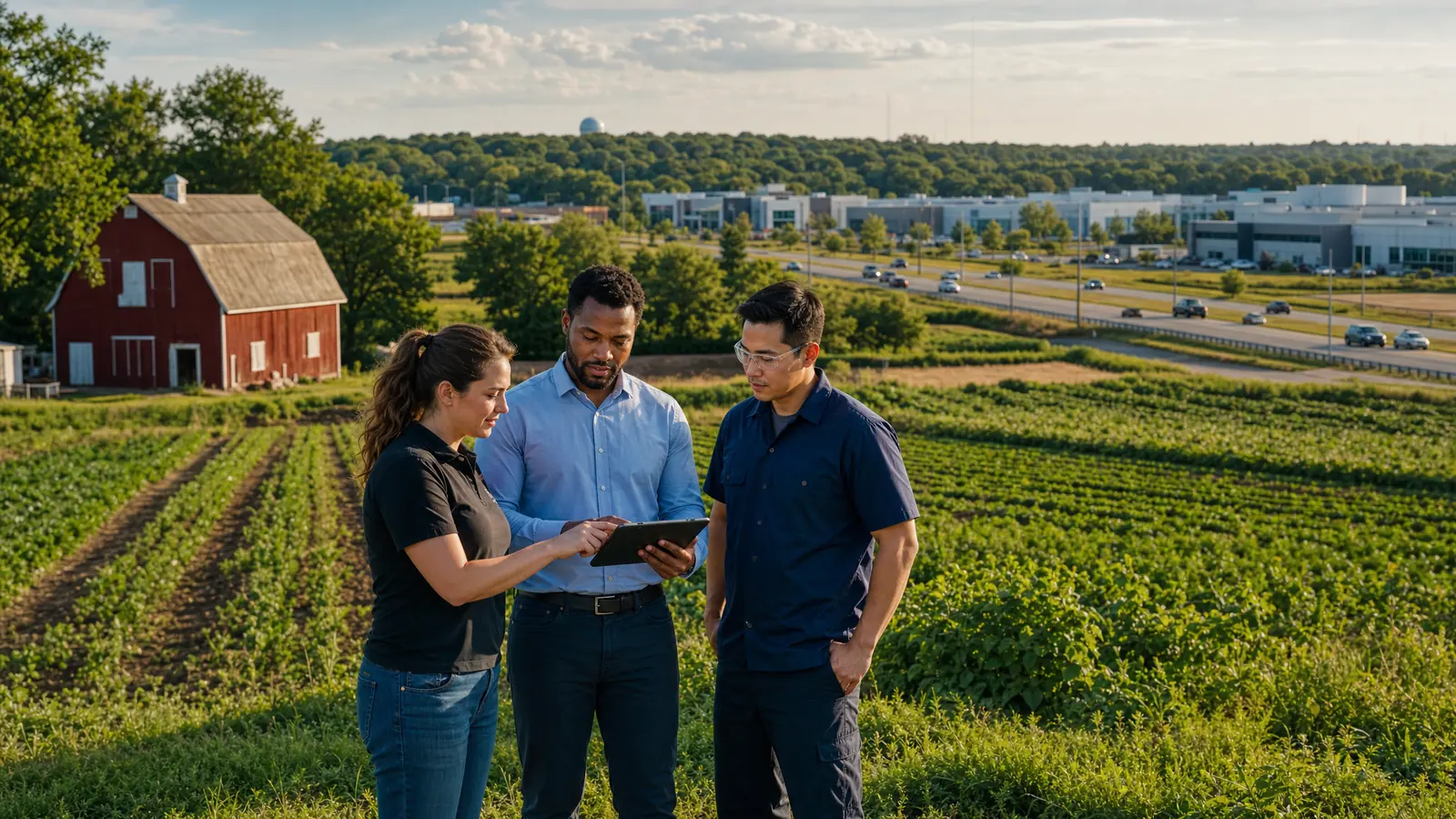
Brooklyn Park’s current business landscape makes more sense when viewed as a sequence rather than a sudden suburban development story. City historical material describes Brooklyn Township farmers at the edge of a growing Minneapolis market. They raised fragile vegetables and other produce that could reach urban buyers quickly, while potatoes and onions could move through the Osseo rail depot. New rail, telephone, automobile, and electric connections shortened the distance between farm work and a larger economy. That early pattern—productive land linked to customers by infrastructure—still offers a useful way to understand the city.
The scale and form have changed. Brooklyn Park now occupies 26.08 square miles and had 86,478 residents at the 2020 Census. The Metropolitan Council identifies four principal arterials in the city: Interstate 94, U.S. Highway 169, Minnesota Highway 252, and Minnesota Highway 610. The city’s northwest planning work describes more than 700 acres north of Highway 610 and around Highway 169 where future development can connect to that regional network. This is not proof that every site or project will succeed. It does explain why production, distribution, technical services, and later-stage development have found a practical metropolitan location here.
Workforce and access
Inclusive system design is an operating requirement, not a demographic assumption8
Brooklyn Park is a city in which workforce access cannot be reduced to a single demographic profile. Census QuickFacts reports that 25.8% of residents were foreign-born and 31.8% of people age five or older spoke a language other than English at home during the 2020–2024 period. Those figures do not prescribe what any employer should build. They do suggest that usable systems, clear terminology, accessibility, multilingual review, and consistent training deserve to be treated as operational design requirements rather than afterthoughts.
From market farming to precision work
The city’s industrial identity reflects both continuity and reinvention5
Historic Eidem Farm preserves the period when Brooklyn Township’s farms supplied nearby urban markets. Its master plan identifies market farming, onions, potatoes, and sheep as central parts of the site’s history. The connection to today is not that biotechnology grew directly out of potato farming. It is that Brooklyn Park repeatedly adapted productive land, transportation, tools, and workforce knowledge to a changing regional market.
Current economic identity
Manufacturing provides the strongest evidence-backed anchor for AI opportunity research132
The city’s 2040 Comprehensive Plan reported that manufacturing represented 17.5% of Brooklyn Park employment in 2016, compared with 11.0% statewide, while health care and social assistance represented another 16.8%. A 2024 city publication described manufacturing as the city’s top industry at almost 22% of its workforce. These figures come from different years and should not be combined as a trend line, but both identify production as an unusually important part of the local employment base. The city’s 2024 Economic Development Authority report builds on that base with plans for a BioTech Innovation District intended to support biotechnology manufacturing, research, and development in the northwest growth area.
A useful AI strategy should therefore begin with the actual disciplines already demanded by this economy: controlled documentation, repeatable production, equipment reliability, supplier coordination, workforce development, and accountable decisions. The opportunity is not to place a chatbot over every process. It is to select bounded tasks where approved information can be retrieved faster, exceptions can be surfaced earlier, and experienced people can spend more time on judgment, investigation, and improvement.
Current economic strengths
Industries shaping Brooklyn Park, MN
Precision and advanced manufacturing139
Manufacturing is the clearest city-specific industry anchor. Brooklyn Park’s comprehensive plan reported a larger manufacturing employment share than Minnesota overall in 2016, and the city’s 2024 publication described manufacturing as nearly 22% of its workforce. At the regional level, Minnesota DEED counted nearly 173,000 manufacturing jobs across the seven-county metro in 2024. Hennepin County’s largest manufacturing subsectors included miscellaneous manufacturing, computer and electronic products, machinery, and fabricated metal products. This mix points toward production environments where specifications, work instructions, inspection evidence, equipment history, engineering changes, and supplier records must stay aligned. The practical pressure is not simply producing more information; it is keeping revisions, exceptions, evidence, and responsibility synchronized across engineering, operations, quality, maintenance, and suppliers. Shift changes, engineering releases, line clearance, training status, calibration, and material substitutions can all change what information is valid for a particular task. AI may help people find and compare approved information, prepare an evidence trail, or focus attention on a defined exception. Uncontrolled generation, hidden source changes, or an interface that blurs advice with authorization would instead create new quality and safety risks.
Medical technology and biotechnology291013
Brooklyn Park’s medical-technology identity is more than a list of company names. The city’s EDA annual report describes an existing health-technology base and a planned district for biotechnology manufacturing and research. DEED reports that most metro employment classified as miscellaneous manufacturing is in medical equipment and supplies, and its statewide 2022–2032 projections anticipate growth in both medical-equipment and pharmaceutical manufacturing. These activities can involve validated processes, design and production records, deviations, complaints, training, and supplier controls. They may also cross organizational boundaries among developers, contract manufacturers, laboratories, component suppliers, distributors, and service providers. That makes traceable handoffs and clear record ownership especially important. An assistant that retrieves the wrong revision or invents a plausible justification can create more review work or obscure a real problem. AI assistance can be valuable only when its intended role, approved data, testing, traceability, change control, and human approval fit the applicable quality system and the consequence of failure.
Logistics, wholesale, and operational services187
The same highway access and available industrial land that support manufacturing also create coordination work around materials, inventory, shipments, vendors, facilities, and customer commitments. The 2040 plan identified wholesale trade as 6.2% of city employment in 2016, above the 4.5% state comparison in that document. Census QuickFacts reports substantial 2022 transportation and warehousing receipts for the city, though receipts are not the same as jobs or local economic output. These functions operate on time-sensitive records that may disagree across enterprise systems, portals, email, spreadsheets, and carrier updates. A model should not hide those disagreements behind a smooth narrative. It should show timestamps, source systems, unresolved conflicts, and the owner expected to investigate promptly. For AI planning, the important point is operational: recurring searches, status checks, reconciliations, and exception decisions may benefit from better information access and clearer ownership, while authorized people retain purchasing, supplier, release, shipment, and customer-commitment decisions.
Practical opportunities
AI applications for local industry workflows
Controlled technical knowledge assistant1113
Workflow: Create a retrieval assistant that searches only approved procedures, work instructions, specifications, equipment manuals, training material, and policy records. Answers should identify the source, revision, effective date, and relevant passage so a worker can verify the response instead of trusting generated prose. Permissions must follow the underlying document system, and expired or superseded records must be excluded from retrieval.
Potential value: The hypothesis to test is faster, more consistent access to governed information during production, maintenance, quality review, onboarding, and customer support. A pilot should measure successful retrieval, citation accuracy, unresolved questions, and escalation time—not merely count chats. The assistant should say when evidence is missing and route high-risk questions to an accountable subject-matter expert.
Required controls
- Approved-source allowlist with revision and effective-date metadata
- Role-based access inherited from systems of record
- Citation and abstention requirements
- Human escalation for safety, quality, or regulatory decisions
Quality-event and audit preparation support1311
Workflow: Assist authorized teams in collecting related records for deviations, nonconformances, corrective actions, supplier issues, and audits. The system may summarize evidence, identify missing fields, compare dates, and draft a chronology, but it should not assign root cause, close an investigation, determine product disposition, or approve a record. Those actions remain with qualified personnel under the organization’s procedures.
Potential value: A bounded tool may reduce time spent locating records and preparing an initial evidence package while improving visibility into incomplete documentation. Evaluation should compare completeness, unsupported statements, reviewer corrections, and cycle time against the existing process. Every summary must remain traceable to original records, and generated text must be clearly distinguishable from approved quality evidence.
Required controls
- Read-only connection to validated source records during initial pilots
- Complete source traceability for each generated statement
- No autonomous root-cause, disposition, closure, or approval
- Documented review and electronic-record requirements where applicable
Equipment maintenance triage1114
Workflow: Combine approved manuals, work-order history, alarm descriptions, spare-parts data, and technician notes to help maintenance staff classify an issue and locate relevant diagnostic steps. Start with low-risk equipment or advisory use. Safety interlocks, lockout/tagout requirements, calibration decisions, and return-to-service authorization remain outside the model’s control.
Potential value: The useful test is whether technicians reach the correct documented procedure sooner and whether repeat symptoms become easier to identify. The system should not promise predictive maintenance without sufficient, representative sensor and failure data. Performance must be monitored across equipment types, shifts, and uncommon faults, with an explicit fallback when confidence or evidence is insufficient.
Required controls
- Equipment-specific validation and known-issue test set
- No control of machinery or safety functions
- Technician confirmation before action
- Monitoring for stale manuals, missing history, and repeated wrong suggestions
Supply-chain and shipment exception briefing811
Workflow: Monitor authorized order, inventory, supplier, and shipment data for defined exceptions such as missing confirmations, late milestones, unexpected quantity changes, or records that do not reconcile. The assistant can prepare a daily exception brief with links to source transactions and the owner responsible for follow-up. It should not place orders, change approved suppliers, release shipments, or communicate externally without authorization.
Potential value: A pilot can test whether teams identify consequential exceptions earlier and spend less time assembling status reports. Precision matters more than alert volume: excessive false alarms can bury the events that need attention. The workflow should define thresholds, ownership, escalation, and a path for correcting source data rather than using generated explanations to conceal discrepancies.
Required controls
- Read-only pilot and explicit transaction boundaries
- Source links and data-freshness indicators
- Priority rules approved by operations and quality owners
- Human authorization for purchasing, release, and external communication
Visual inspection decision support1311
Workflow: For a narrowly defined part and defect class, computer vision may help sort images for review or flag possible anomalies. Before operational use, the organization needs representative images, known-good measurement practices, acceptance criteria, lighting and camera controls, versioned models, and testing across realistic variation. The model’s output should feed a controlled review process rather than silently determine product acceptance.
Potential value: The initial objective may be more consistent review queues or faster attention to unusual observations, not replacement of trained inspectors. Measures should include false accepts, false rejects, subgroup and lot performance, drift, reviewer disagreement, and the impact of changes to materials, tooling, imaging, or suppliers. If the evidence does not meet the defined threshold, the system should remain experimental.
Required controls
- Representative validation set and documented acceptance thresholds
- Human disposition authority
- Camera, lighting, calibration, and model-version controls
- Drift monitoring and revalidation after material process changes
Multilingual training and workforce access811
Workflow: Use AI to draft plain-language or multilingual explanations of approved training content, then require review by qualified personnel and competent language reviewers before release. The governed source remains the official instruction. A learner should be able to move from the explanation to the exact approved procedure and request help when terminology, literacy, accessibility, or job context makes an answer uncertain.
Potential value: Brooklyn Park’s population data makes inclusive access a relevant design question, but it does not prove a particular employer’s language need. Organizations should test comprehension with their own workforce and workflows. The opportunity is clearer onboarding and better access to approved knowledge; the risk is a fluent translation that subtly changes a safety, quality, or technical requirement.
Required controls
- Human-reviewed terminology and translations
- Direct link back to the controlled source
- Accessible interface and non-digital fallback
- No replacement of required qualification, demonstration, or supervised training
Risk and accountability
Security, privacy, safety, and compliance
Approved data and least privilege1411
Every system should begin with a data map: which records are allowed, where they reside, who owns them, who may retrieve them, how long logs are retained, and what must never enter an external model. Production, employee, customer, supplier, health, and regulated records require different handling. Connections should use least privilege, secrets should be managed outside code, access should be reviewed, and outputs should not become an ungoverned copy of controlled information.
Human authority and safe failure1112
The person accountable for a decision must remain visible. The system needs explicit abstention conditions, escalation routes, override logging, and a safe manual process when data is missing, a service is unavailable, or output conflicts with a controlled requirement. High-impact actions—quality disposition, equipment release, medical or employment decisions, supplier approval, and external commitments—should never be inferred from a conversational interface or delegated merely because the output sounds confident.
Risk-based validation and change control1311
Testing should reflect the intended use and foreseeable failure modes. A useful package records requirements, representative test cases, source versions, prompts or configuration, model version, results, deviations, approval, and rollback. Changes to data, integrations, policies, models, or workflow scope can invalidate earlier evidence. For regulated manufacturing, the organization must determine how its quality system and FDA requirements apply; an AI vendor cannot declare the customer compliant.
Security, monitoring, maintenance, and upgrades1412
A production AI solution is a maintained software system, not a one-time prompt. It needs vulnerability management, dependency and access review, availability monitoring, quality metrics, incident handling, data and model drift checks, backup and recovery, and controlled upgrades. Operational dashboards should distinguish system health from answer quality and identify which version produced an output for later investigation and correction. A service can be technically available while producing stale, unsupported, or unsafe responses.
Authorized and recovery-gated
Continuous security validation for local industries
These scoped validation patterns preserve written authorization, recovery readiness, evidence, and accountable human decisions. They do not start testing or scanning from this page.
Continuous security validation for precision and advanced manufacturing139
Protected operations
In the Brooklyn Park, MN context, protect approved specifications, work instructions, inspection evidence, equipment and maintenance history, engineering-change records, supplier files, production identities, and the configurations that connect those records.
Change triggers
- Revalidate after engineering releases, work-instruction revisions, dependency or certificate updates, equipment-interface changes, permission changes, or manual production-configuration edits.
- Recheck supplier integrations, quality-data flows, calibration or maintenance interfaces, device identities, network rules, and recovery procedures after material changes.
Validation coverage
- Within verified written authorization and exact target scope, check role separation, approved-revision retrieval, configuration drift, audit-event capture, integration failure behavior, and release evidence without issuing real production instructions.
- Use a representative mirror first, synthetic accounts or disposable data where practical, harmless markers, and minimum-proof stopping; any bounded production confirmation requires separate human approval.
Recovery readiness
Verified recovery readiness requires an isolated, successfully restored and functionally checked path that can restore approved specifications, configuration baselines, identity mappings, quality evidence, and integration settings in an isolated environment before any target confirmation.
Human boundaries
AI analysis remains advisory. Human approval controls engineering release, quality disposition, production restart, exception acceptance, and restoration; AI cannot authorize targets, accept risk, approve release, or modify production. Qualified people determine whether FDA, OSHA, contractual, or other requirements apply; validation is not certification. This bounded engagement cannot guarantee security, compliance, or prevention of every incident.
Business value
For this operating context, continuous validation helps reviewers detect when a software or configuration change separates production activity from its approved instructions and evidence.
Continuous security validation for medical technology and biotechnology291013
Protected operations
In the Brooklyn Park, MN context, protect design and production records, controlled documents, device-history evidence, complaint and corrective-action information, supplier exchanges, regulated-system identities, and validated configurations.
Change triggers
- Revalidate after quality-system software releases, model or workflow revisions, electronic-signature changes, supplier-portal updates, permission changes, and dependency or certificate updates.
- Recheck data lineage, retention, export, approval, complaint-routing, corrective-action, and manufacturing-system connections when a regulated workflow changes.
Validation coverage
- Within verified written authorization and exact target scope, test least privilege, record integrity, approval sequencing, source traceability, audit trails, retention behavior, and bounded failure paths with synthetic device and quality records.
- Use a representative mirror first, synthetic accounts or disposable data where practical, harmless markers, and minimum-proof stopping; any bounded production confirmation requires separate human approval.
Recovery readiness
Verified recovery readiness requires an isolated, successfully restored and functionally checked path that can prove restoration of controlled documents, audit history, configurations, identities, integration mappings, and required quality evidence before target testing.
Human boundaries
AI analysis remains advisory. Human approval controls quality approval, device or process release, complaint escalation, corrective action, risk acceptance, and production restoration; AI cannot authorize targets, accept risk, approve release, or modify production. Qualified reviewers determine FDA QMSR and other regulatory applicability; the assessment cannot certify compliance. This bounded engagement cannot guarantee security, compliance, or prevention of every incident.
Business value
For this operating context, continuous validation provides reviewable evidence that digital changes did not silently weaken record control, approval, traceability, or recovery.
Continuous security validation for logistics, wholesale, and operational services187
Protected operations
In the Brooklyn Park, MN context, protect inventory and location records, order and shipment status, routing rules, supplier and carrier connections, warehouse identities, customer communications, and exception queues.
Change triggers
- Revalidate after warehouse, order, routing, scanning, label, carrier, EDI or API releases and after permission, certificate, network, or device changes.
- Recheck inventory adjustments, exception routing, customer notifications, vendor connections, exports, and manual administrative settings when operating rules change.
Validation coverage
- Within verified written authorization and exact target scope, exercise authorized role boundaries, inventory reconciliation, duplicate and delayed message handling, label and routing safeguards, alerting, and integration rollback using disposable orders.
- Use a representative mirror first, synthetic accounts or disposable data where practical, harmless markers, and minimum-proof stopping; any bounded production confirmation requires separate human approval.
Recovery readiness
Verified recovery readiness requires an isolated, successfully restored and functionally checked path that can restore inventory snapshots, order state, routing and label configurations, identity mappings, integration checkpoints, and reconciliation evidence before bounded confirmation.
Human boundaries
AI analysis remains advisory. Human approval controls inventory correction, shipment release, exception override, customer notification, risk acceptance, and service restoration; AI cannot authorize targets, accept risk, approve release, or modify production. Operational and contractual obligations remain organization-specific; validation does not guarantee service continuity or compliance. This bounded engagement cannot guarantee security, compliance, or prevention of every incident.
Business value
For this operating context, continuous validation can expose control drift that would otherwise turn an integration or permissions change into missing inventory, duplicate work, or unreviewed routing decisions.
Formal software lifecycle
From scoped opportunity to maintained system
- 01
Define the workflow and risk boundary
Map the current work, source systems, users, approvals, exceptions, regulatory obligations, failure consequences, and baseline measures. Select a bounded problem with an accountable owner and a manual fallback.
- 02
Design permissions, evidence, and human control
Specify approved data, retrieval rules, integrations, roles, citations, abstention, escalation, logging, retention, accessibility, and the decisions the system is prohibited from making.
- 03
Build a contained pilot
Use representative but minimized data, separate development and production, version configurations, protect credentials, and create a testable interface that makes sources and uncertainty visible.
- 04
Test against requirements and failure cases
Measure accuracy, retrieval, unsupported output, access control, latency, recovery, accessibility, and human-review performance. Include uncommon, ambiguous, stale, adversarial, and unavailable-data cases before approval.
- 05
Deploy, monitor, maintain, and improve
Release through controlled stages, monitor technical and outcome measures, document incidents and corrections, review permissions, test backups, and require impact assessment and regression testing for every material upgrade.
How this report was prepared
Methodology and evidence limits
IMS reviewed municipal planning and economic-development documents, federal demographic data, Minnesota labor-market analysis, state legislative records, historical materials, and captioned civic-news videos accessed on August 26, 2026. Local facts were accepted only when supported by an authoritative source; promotional forecasts and company statements were treated as context rather than established outcomes. The AI applications below are proposed workflow opportunities, not claims that local organizations use these systems or that a particular benefit is guaranteed. Every implementation would require organization-specific discovery, risk assessment, validation, and approval.
Evidence
Sources
- 2040 Comprehensive Plan, Chapter 6: Economic DevelopmentCity of Brooklyn Park, 2020-03-30
- Brooklyn Park Economic Development Authority 2024 Annual ReportCity of Brooklyn Park, 2025-05-19
- Brooklyn Park continues to be a hub for jobs and corporate growthCity of Brooklyn Park, 2024-01-01
- Learn about Eidem Farm: History of Eidem Farm, 1905–1920City of Brooklyn Park, 2026-08-26
- Eidem Homestead Master PlanCity of Brooklyn Park, 2018-07-09
- Northwest Growth Area PlanCity of Brooklyn Park, 2026-08-26
- Brooklyn Park 2040 System StatementMetropolitan Council, 2015-09-01
- QuickFacts: Brooklyn Park city, MinnesotaU.S. Census Bureau, 2026-08-26
- The Specialization of Manufacturing in the MetroMinnesota Department of Employment and Economic Development, 2025-09-15
- 2022–2032 Minnesota Long Term Employment ProjectionsMinnesota Department of Employment and Economic Development, 2024-09-01
- Artificial Intelligence Risk Management Framework (AI RMF 1.0)National Institute of Standards and Technology, 2023-01-26
- Artificial Intelligence Risk Management Framework: Generative Artificial Intelligence ProfileNational Institute of Standards and Technology, 2024-07-26
- Quality Management System Regulation (QMSR)U.S. Food and Drug Administration, 2026-02-02
- Secure by DesignCybersecurity and Infrastructure Security Agency, 2023-04-13
- Brooklyn Park Seeks To Create ‘Biotech Innovation District’CCX Media Community News, 2024-04-05
- Brooklyn Park Works To Build Biotech Innovation DistrictCCX Media Community News, 2024-07-01
FAQ
Questions about AI and Brooklyn Park, MN
Does IMS claim to have an office or clients in Brooklyn Park?
No. This report analyzes public information about Brooklyn Park industries and proposes workflow opportunities. It does not claim a local IMS office, client relationship, endorsement, or completed project.
Which Brooklyn Park workflows are the best candidates for an AI pilot?
A good first candidate is bounded, repetitive, measurable, supported by approved data, and safe to return to a manual process. Controlled document retrieval, exception briefing, and evidence assembly are often easier to govern than autonomous decisions or equipment control.
Can an AI system make a manufacturer FDA compliant?
No. Compliance belongs to the regulated organization and depends on its products, intended uses, processes, records, validation, controls, and applicable law. AI can support parts of a governed workflow, but it cannot confer compliance.
How should a medical-technology organization evaluate AI output?
Define the intended use, risk, representative test set, acceptance thresholds, human review, traceability, failure handling, monitoring, and change-control requirements before deployment. The rigor should match the consequence of an incorrect or unavailable output.